Monday, November 15, 2010

Beauty at the Bottom - What is it? The story. And a bit of "how to".


"Beauty at the Bottom: Red Wine 2"


The above photograph is one of my best sellers of all time. When people view it, they either know exactly what it is and smile big, or they ask "what is that?" If you need a little help, think of the view your tonsils would get if you took a big swig straight out of your favorite wine bottle while watching television. Still confused? What you are looking at is a red wine bottle tilted on it's side with a little bit of the beverage still in it. The camera lens is small and is looking right down inside the mouth of the bottle. For this shot, a television behind the bottle provides the main light source, creating a magical colorful kaleidoscope-like view of a magical beverage.

The whole "Beauty at the Bottom" series has made me a decent amount of money, but it also gets me involved in many fun conversations. Once people get past the "what is that?" guessing game, they always want to know how I came up with the idea. Photographers always want to know how I shot it. So, I thought I'd share...
It all started back in 1997 when I moved to South Lake Tahoe for a winter to live with my sister and to work as a photographer at Heavenly Ski Resort. When I first moved and arrived at her home in my car filled with all my belongings (not much), she was out of town so I had the place to myself for a couple days. I didn't know anyone in town yet so after I settled in, I picked up a 6 pack of beer and turned on the TV. After about the fourth one, for some reason I looked down inside the almost empty bottle. I saw the light from the television dancing around, reflecting off the glass and liquid, creating psychedelic colors I had to capture. 

So, I got out my trusty old camera and had some fun shooting down inside the bottles for a while.  A few  8x10's of those original images are out there somewhere but they are no longer available for purchase. I hand held the bottle for those photos so they were slightly out of focus and they no longer make the cut.  Lesson learned...

That brings us to the "how". Most of the beer and wine photos in the series were shot in 2002 on 35mm Fuji Velvia slide film with my Olympus OM-1. Most of the new tequila photos were shot on my Canon 1Ds Mark III, a digital camera. But the one thing all the photos in this series have in common, and the big secret, is the lens I used. It is an old Quantaray macro lens that my Grandfather gave me, 55mm 1:3 with an Olympus mount. I now own an adaptor for the lens so I can use it on my Canon digital cameras. The thing that makes this lens work is the size of the glass on it, which is about the size of a quarter. It butts up perfectly with the mouth of the bottle and I can photograph down inside it. All of the 2002 and older photos in this series were photographed with a television behind the bottle to provide light and color. The new ones have a variety of backgrounds like poster board, computer monitor, fire, and snow with a variety of lighting types. Pictures are worth a thousand words so here's a few of the set up. 


Photograph using an El Ultimo Agave tequila bottle. CLICK HERE to view the result of this set up. 


Photograph using a Fortaleza tequila bottle. CLICK HERE to view the result of this set up. 


Photograph using a Corralejo tequila bottle. CLICK HERE to view the result of this set up. 


As you can see in the bottom example, I use two tripods for these photos. The exposures vary and can be anywhere from a fraction of a second to thirty seconds long. Taping the bottle to a second tripod or stabilizing it by some other means is a must if you want sharp photos. I also use mirror lock up and a shutter release cable for even less camera shake and therefore sharper photos. The aperture settings also vary as different depth of fields can create a very different look to the same bottle and setup. 

Oh yeah, another common question is "Did you use photoshop to get those colors?" Although I do use Photoshop to process my raw digital images or scanned 35mm slides, I make only very minor adjustments to the contrast, color, and other basic settings to match the slide or what I saw.  If you were to look down inside the bottle with your eye, you would pretty much see the same thing that is on the final print. Disclaimer: Do not look down inside your bottle of alcohol, alcohol burns when it spills on your eye, not responsible for any damage to your eye or to your camera should you try to recreate these photos....


"Beauty at the Bottom: Tequila 8"
 

Most of the backgrounds and lighting I use are all about getting a certain color I want. But the image above is a little different. Casa Noble Tequila is an organic tequila, so that inspired me to use organic lighting and background colors. This one was shot outside using natural sun light and some snow covered rocks behind the bottle were used to add a bit of color to the light blue bottle.

So, there's a bit about some of my most fun images that work great as conversation pieces. I hope you enjoy the photos and the story. If you have any questions about them, please post a comment below and ask.  Here's a slideshow of the whole series, CHEERS!

-Scott Thompson

For purchasing information, please view the "Beauty at the Bottom" gallery and click on individual images. Available as large fine art prints, gift items, and as stock photography. 


Friday, November 5, 2010

Fall Color Photography in the Tahoe and Truckee Area.


Despite having an rough start to my fall photography season up here in Truckee, CA, I'm pretty happy with it so far. It started out looking like it was going to be a great year but before the yellow colors in  the aspen and cottonwood really peaked, we had high winds, heavy rain, and a little snow storm. This knocked off most of the yellow leaves around the Tahoe area. I was bummed but the little bit of snow we did get mixed with the little bit of yellow did make for a decent photo: 


"Shack near Brockway Summit 2" - This old shack was photographed along Hwy 267 near Brockway Summit, CA on a snowy fall morning.


It took a while for the green leaves that were left on the trees in the area to yellow up but they eventually did and I got out for a hike to an area I've wanted to go to for years but never have. John Staab of A Day In Your Life Photography and I hiked up to Marlette Lake from the Spooner Lake parking area. The hike took a little longer than we thought it would but it was well worth it. Most of the area's aspens had lost their leaves as well but there was a pretty large patch still looking great. The wind and water were calm so I had some fun shooting aspen reflections on the surface of Marlette Lake. I think they came out with a very "painted" look that I'm very pleased with:


The highlight of the Marlette Lake hike happened right as I was feeling like I had got all the shots I wanted and was ready to call it a day. All of a sudden John noticed a beaver swimming away from the shore, not too far from us. I got to see the beaver swim across to some younger aspen, bite off a chunk of the tree, and swim it back to his home: 


"Beaver at Marlette Lake 1" - This busy beaver was photographed moving a piece of aspen at Marlette Lake, Nevada.

A couple days after the Marlette Lake hike, I wanted to get some good shots of Downtown Truckee in the fall. I live in Truckee and this is another subject I needed more photos of. I drove around to different spots but I didn't even take out my camera, the leaves in downtown had not peaked just yet. However, yesterday I got out to Downtown Truckee again and I was much happier. The clouds made it a little difficult as the yellows don't pop as much when they're in the shade. But patience paid off, the sun peeked through a few times, and I got some great photos of the town I love: 


"Downtown Truckee in the Fall 2" - This is a photograph of homes and buildings in Downtown Truckee, CA in the fall.


"Truckee River in Autumn 2" - These cottonwood trees were photographed in autumn at the Truckee River in Downtown Truckee, CA.

All in all, I've had a pretty good fall photography season, and there's still a little bit left. We're expecting some bad weather later this weekend so I may have to get out again tomorrow before it all gets blown away until next year. 

-Scott Thompson


The photographs above are available as fine art prints, gift items, and as stock photography. Please see www.ScottShotsPhoto.com for more info. 

Thursday, September 9, 2010

My Kayak, What a Great Photography Tool.

Scott Thompson fishing and shooting on Lake Tahoe. Photographed with a Motorola Droid.


Last summer, my wife and  I decided to spend a few hundred bucks and buy a tandem sit on top kayak for the family. The purchase was supposed to be about family fun and fishing, it has held me, my wife, my son, and my 85 pound Labrador all at once. "The Orange Peel", it's nickname, has been well worth the money. But I have also found it to be an incredible addition to my camera bag.

The kayak is an Equinox 160T from Costco. The price was way below anything else I had been looking at online. My expectations weren't very high but I have found it to be perfect for my needs. Very stable and a whole lot of space for family and/or camera gear. The front seat has held my big fully loaded camera bag in a large dry bag and I've even stood up in the kayak for photos. (Note: Dry bags are a MUST if you plan on bringing a camera you value onto small paddle driven boat, drips happen, many many drips, oh, and don't forget splashes and sloshes. A small towel is also recommended.)  The kayak comes stock with a small covered hatch that keeps things relatively dry but water has unexpectedly gotten in there when the family was using it for play. If you own this kayak, don't trust the hatch for H2O sensitive camera gear.  Also, don't plan on winning any kayak races with this beast, slow and steady wins for photography purposes.

I've customized my kayak a bit. Online I found two flush mount fishing pole holders and a 4" hatch to provide a little more entertainment value and access to the large interior of the boat creating more storage.  These inexpensive additions have been priceless. Trolling for fish on the way to photography locations is a great way to make good use of work hours.


Scott's son Kane kayaking and fishing on Donner Lake.


When I'm with the whole family, wife and dog included, I skip all cameras but my cell phone.  When fishing with just my son, I bring just one camera body, one lens, flash, and polarizing filter. As always a dry bag is a must but I skip the tripod and additional gear. Space is limited and my attention to photography is also limited. But when I'm by myself, this kayak provides plenty of space for all my outdoor gear, 2 Canon bodies, 4 lenses, flash, tripod, and a whole lot of random accessories I rarely need until I don't have them.  I own three dry bags of different sizes and I use the smallest I can get away with.

The low angle  you get when you shoot from a kayak can be a good and a bad thing. It can provide some incredible photogenic angles but the glare and/or reflections on the water requires a polarizing filter most of the time to remove the glare. When you use a polarizer filter you lose a lot of light (kind of  like sunglasses for your lens)  so shooting from the boat handheld can be a bit more of a challenge. I usually use an ISO of 400 and a shutter speed no slower then 1/160 of a second.  Later in the day when more gasoline powered boats get out and about, the waves can really pick up. This can require even faster shutter speeds. It can also require you to ditch the shoot and quickly toss your gear into your dry bag. Safety of camera gear first, I can swim.

Lake Tahoe has 71 miles of incredible shoreline but much of it is inaccessible by foot due to private property or rough/steep terrain. Although I haven't kayaked all 71 miles, I have accessed a whole lot of areas I could never have dreamed to get to without it. Getting in close and bumping rocks is no problem either like it would be on most other watercraft.  Quickly beaching it in rocky areas and setting up the tripod for a shot has been great as well.


Photographed from a kayak with a polarizer filter.


The kayak has also proven to be great with helping me photograph birds. They seem to let me get a whole lot closer on water than on land. Getting out early can provide some incredible fog on the water images like this:


Canadian Goose and fog photographed from a kayak.


If you are a photographer or just want to get a better look at mother nature, I would highly recommend purchasing a kayak. After much use, the Equinox 160T gets two thumbs up from me. Kayaking is green and good exercise as well.

Please enjoy this sideshow of images that I have photographed from my kayak or from shore line that I kayaked to. Click the full screen icon for a better view. Are you a  kayaker? Please comment and/or post a link to a favorite kayak photo of you or that you have shot, or a favorite kayak photo story. Have a question about one of the images, ask me.


These images in the slideshow above of Lake Tahoe, Donner Lake and Prosser Reservoir were all photographed from my kayak or from shoreline that I kayaked to. All are available as large fine art prints, gift items, and as stock photography

-Scott Thompson


Thursday, June 3, 2010

Fishing and Photography on Lake Tahoe

Fishing and photography go great together, and when it's on Lake Tahoe, well, just view the slide show below. I'm lucky to have a friend with a small aluminum fishing boat and an addiction to trolling for  Mackinaw. He gets out a ton and I've joined him a couple times this spring with my fishing and photography gear. Both trips left me with no fish but plenty of photos. He has caught a Mack on both trips...


Not only did I get some fun photos of fishing poles and of the boat, but I shot a bunch of landscape and stock photos while trolling along the West shore of  Lake Tahoe. The quickly changing shoreline can be a lot of fun shooting from a boat.


Lake Tahoe from a Fishing boat - Images by Scott Thompson

When shooting Lake Tahoe from a small fishing boat, weather resistant gear is highly recommended. I bring minimal gear, my Canon 5D Mark II, a 24-105 L lens, a flash which I've never used out there, and a polarizing filter. The small camera bag fits into my small dry bag, which gives me peace of mind when I'm not shooting. Both times I've been out this spring it has snowed or hailed on us. The weather can change fast but can provide some beautiful scenery.  Dress warm with layers and a waterproof jacket if you suspect you may encounter some weather. I'd also recommend bringing a rag to wash and dry your hands between fishing and shooting for obvious reasons.

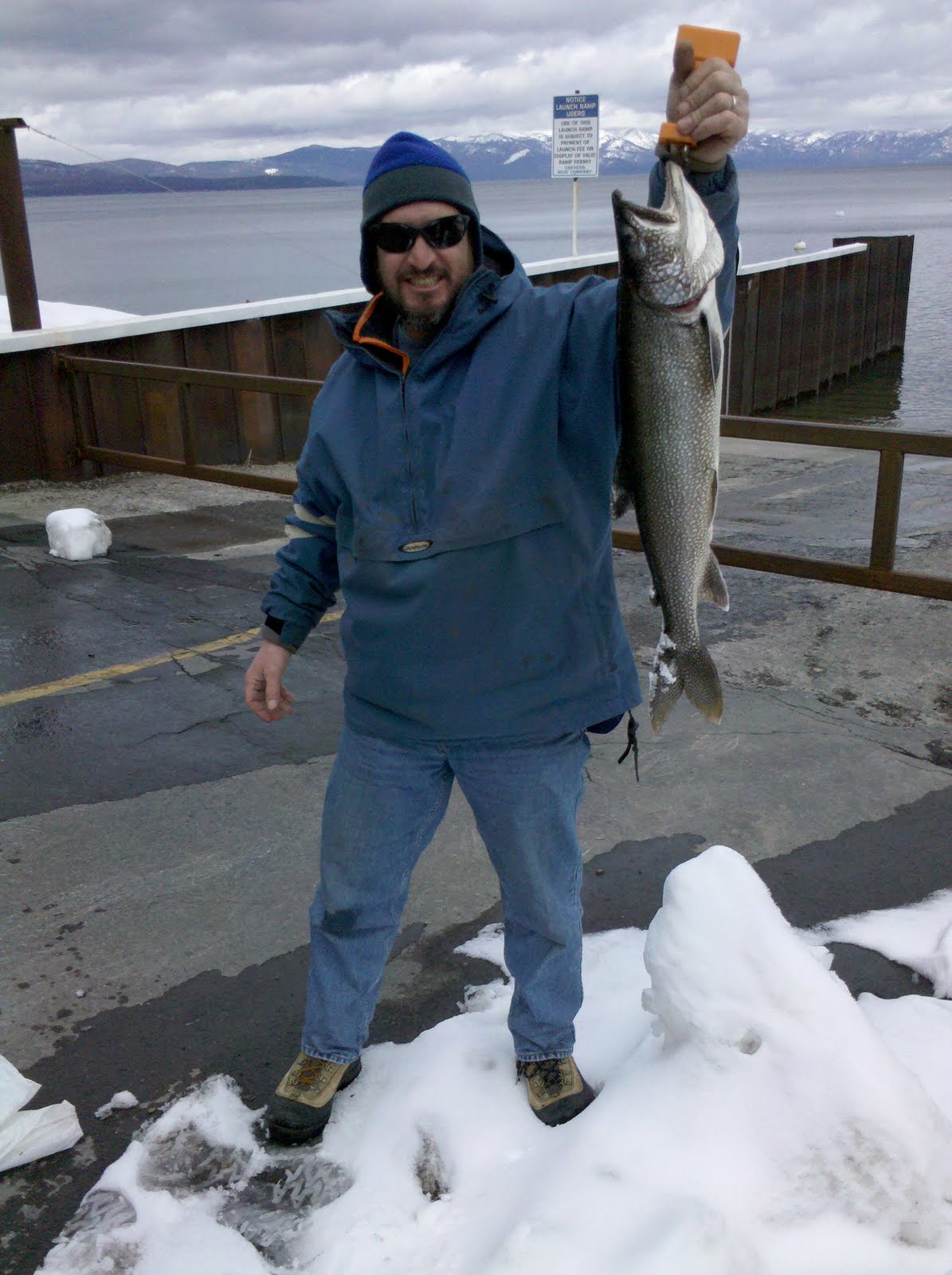
I wish I could give some great fishing tips, but as I mentioned, I got skunked both times. My buddy caught his big Mackinaw on our first trip with a red and blue pattern Rapalla in about 15 feet of water. The waves were a bit too big for his boat when we came around a point so we had to U turn and head back to the calmer waters. Right then he snagged a "rock", we turned around again to save the lure, and when we got closer, he realized he had actually hooked a huge fish.

Photographed on a Motorola Droid


The second fish was caught on the second trip with a big lure attached to a new down rigger in fairly deep water. It started snowing/hailing on us and just as we were about to call it a day, he landed another Mackinaw.  Then we called it, we'll have to bring waterproof pants next time...

Photographed on a Motorola Droid


The Lake Tahoe photos in the slideshows above are available as fine art prints, gift items, and as stock photography. Click on the slideshows for purchasing information. Thank you.