Sunday, July 19, 2026

Shooting Mono Lake's Tufa Towers at Midday: Light, Polarizers, and the Art of Showing Up

There’s a rule most landscape photographers live by: don’t shoot in midday light. The sun is overhead, shadows go flat, and everything looks like a snapshot compared to what it could be at golden hour. I was on Highway 395 last month, heading home to Truckee after a fishing trip with my brother in Mammoth Lakes, and the turnoff for Mono Lake’s South Tufa area was coming up fast. It was one-thirty in the afternoon. Wrong time of day. I turned anyway.

What followed was one of the more instructive shoots I’ve had in a while — and one of the more rewarding. The conditions forced me to solve problems I wouldn’t have faced at sunrise or sunset, and the solutions produced images I genuinely love. Here’s what I found, what I shot, and what I’d do exactly the same again.
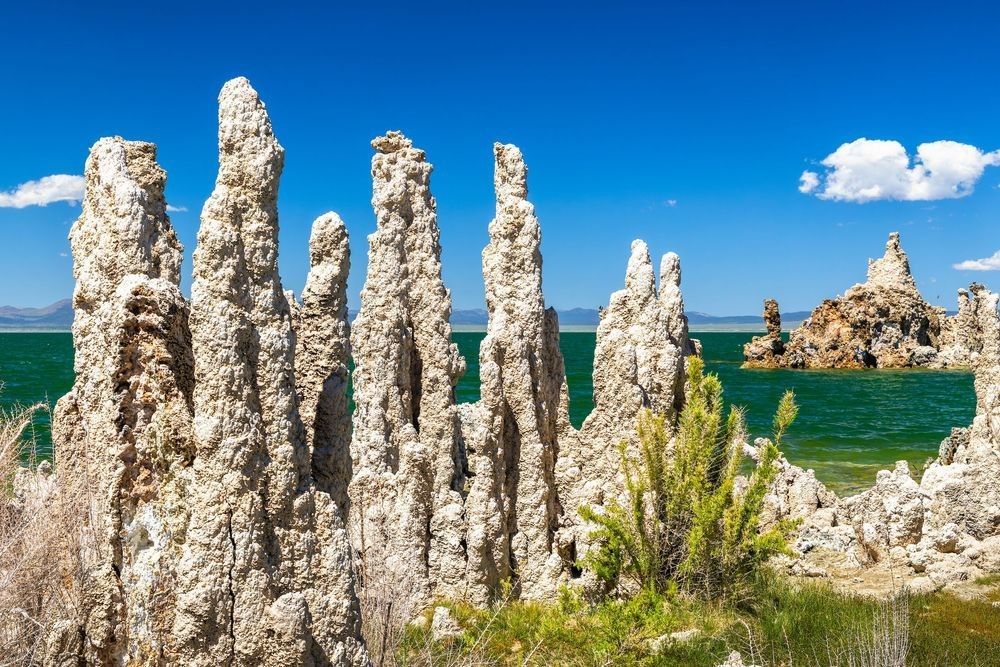
"Tufas at Mono Lake 19" - A dense cluster of jagged tufa spires rises from the shore of Mono Lake at the South Tufa area near Lee Vining, California, in the Eastern Sierra. Dry grasses and green shrubs grow among these weathered calcium carbonate formations, set against the lake's aqua-green water, distant mountains, and a blue sky — one of California's most iconic and otherworldly natural landscapes.

Tufas at Mono Lake 19 — the South Tufa area near Lee Vining, California. Click to view fine art print options.

What You’re Looking At

The tufa towers at Mono Lake are one of those subjects that looks like it should be computer-generated. Limestone spires — some reaching thirty feet or more — rise from the surface of a lake that runs two and a half times saltier than the ocean. The color palette is immediately striking: chalky white formations against water that reads aqua-green or electric blue depending on the light and how you’ve dialed in your polarizer. There’s genuinely nothing else like it in the California landscape.

The formations are calcium carbonate — limestone — built over thousands of years by freshwater springs reacting with the lake’s carbonate-rich water. They grew entirely underwater. The reason they’re visible now is that Los Angeles began diverting the feeder streams in 1941, and as the lake level dropped, formations that had been quietly building in the dark were suddenly standing in open air. The Mono Lake Tufa State Natural Reserve was established in 1981 to protect them. Partial water restoration began in the 1990s, but the lake remains below its historical level — which means the towers we’re photographing today exist precisely because of that history.
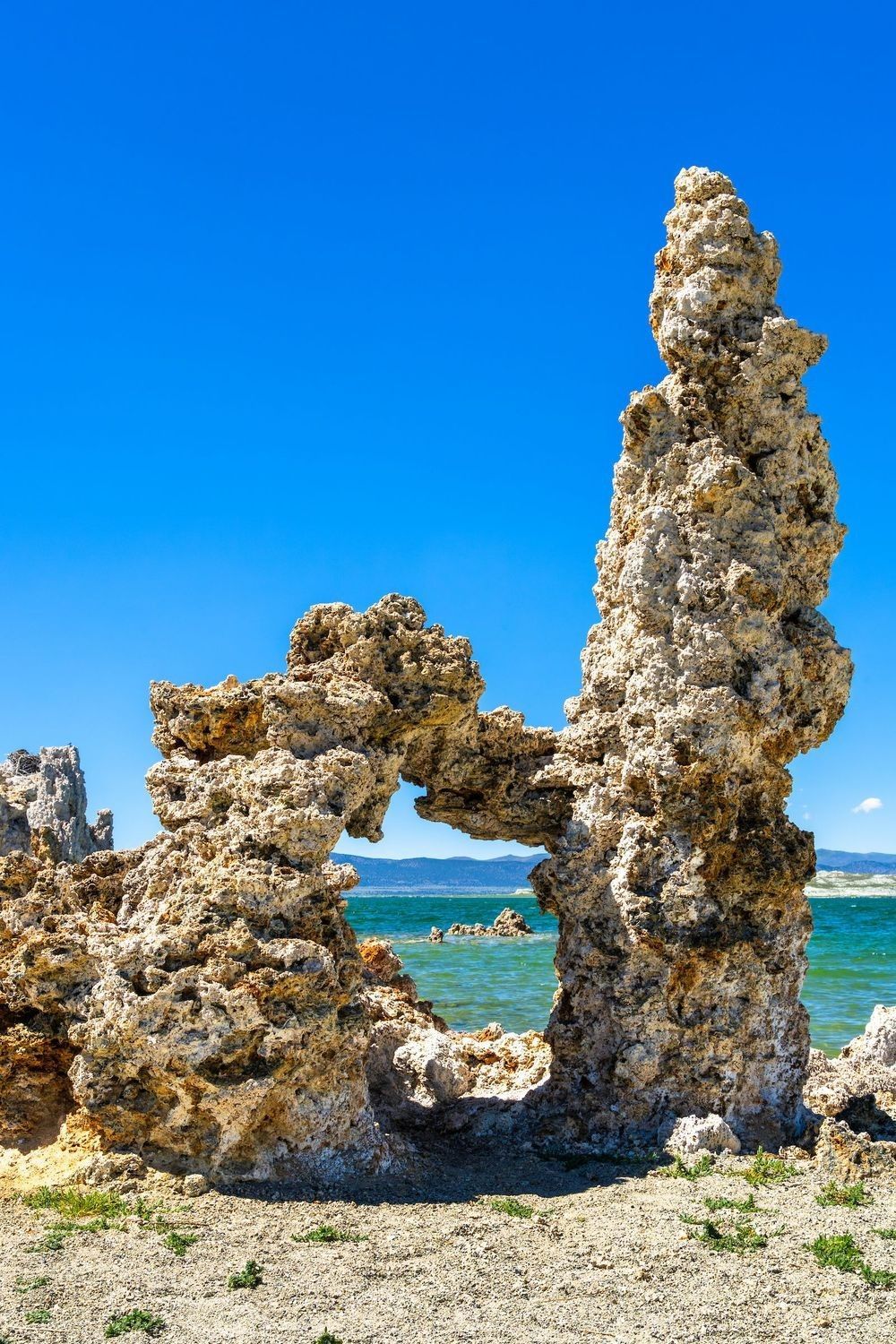
"Tufas at Mono Lake 22" - Weathered tufa formations join to form a natural arch at Mono Lake's South Tufa area near Lee Vining, California, in the Eastern Sierra. The opening frames a view through to the aqua-green lake, distant mountains, and clear blue sky, highlighting the intricate, sculpted texture of these calcium carbonate towers — one of California's most iconic and otherworldly natural landscapes.

Tufas at Mono Lake 22 — weathered formations create a natural arch framing the lake beyond. Click to view fine art print options.

Two Areas Worth Knowing About

The main South Tufa area charges a three-dollar entrance fee collected at a credit card kiosk. Boardwalks and well-worn trails bring you right to the water’s edge, and the formation density here is the highest on the lake. You can work close, work wide, and find interesting angles almost anywhere you point the camera. Volunteer rangers were on-site when I visited — one had a spotting scope trained on an active osprey nest — and the interpretive signage throughout is genuinely good. Families and casual visitors mix comfortably with photographers here.

A short drive west is a second free parking area with a different cluster of formations and far fewer people. This is where I found a wide sandy beach with California gulls spread across it, tufa towers rising behind them, and the snow-capped Sierra Nevada peaks on the horizon beyond. The compositional possibilities there are broader and more expansive than the main area, and I had most of it to myself. Worth the extra few minutes to find.
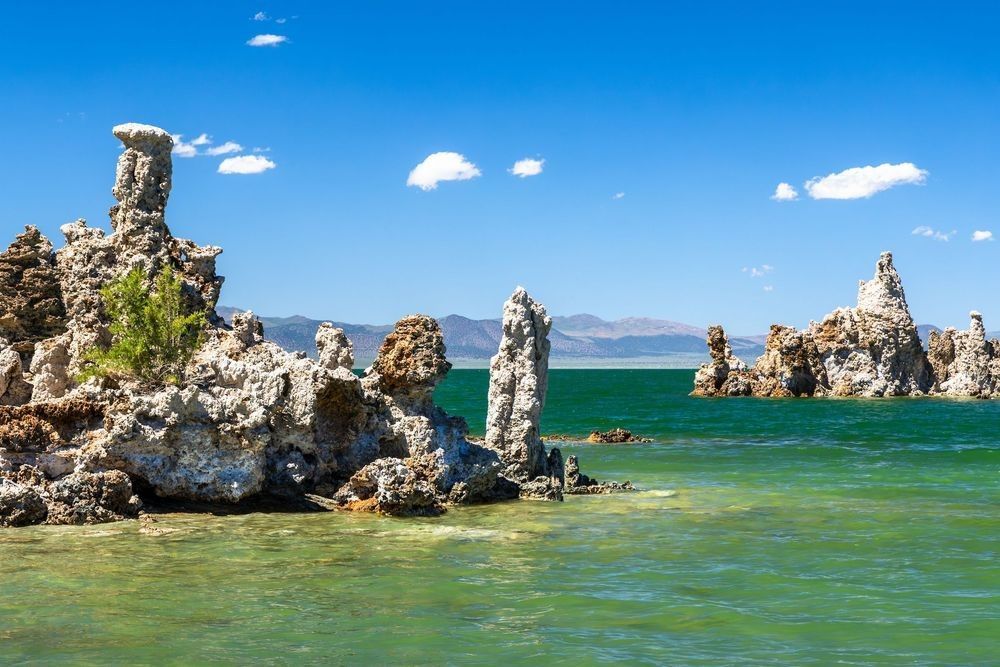
"Tufas at Mono Lake 16" - Dramatic tufa towers rise from the aqua-green waters of Mono Lake at the South Tufa area near Lee Vining, California, in the Eastern Sierra. These striking calcium carbonate formations stand against distant mountains and a vivid blue sky dotted with clouds, one of California's most iconic and otherworldly natural landscapes.

Tufas at Mono Lake 16 — dramatic towers against a vivid blue sky at the South Tufa area. Click to view fine art print options.

The Shoot: Midday, a Polarizer, and an Unexpected Foreground

I’ve shot Mono Lake before — a dedicated sunset session back in 2010 with a Canon 5D Mark II that gave me images I’m still proud of. That golden-hour light on the formations is extraordinary and worth planning around if you have the time. This visit, arriving at one-thirty with a long drive home ahead of me, wasn’t that. It was midday or skip it entirely.

The thing that changed the equation was a circular polarizing filter. Mono Lake at midday in summer gives you exactly the conditions where a polarizer works hardest: bright overhead sun, a highly reflective lake surface, white clouds against a deep blue sky, and striking white formations that need contrast to read properly in-frame. The filter cut through the surface glare and turned the water from a pale wash to a deep, saturated aqua. It made the clouds pop. It pushed the sky darker and let the white tufas stand out with genuine graphic force against it. This is now on my essential gear list for any future Mono Lake shoot, regardless of time of day.

I shot mostly at f/16 — foreground tufas, mid-ground formations, and distant Sierra peaks all demanded a deep depth of field — handheld at 1/200th of a second with ISO varying as conditions shifted. A tripod would have given me tighter control over the compositions where I wanted everything from six feet to six miles in sharp focus, and I’d bring one on a planned shoot. This time I made it work handheld.

One unexpected gift: yellow pollen floating on the lake surface near both areas. I normally work around pollen in water — it’s a familiar problem at Tahoe and Donner Lake and usually reads as a distraction. At Mono Lake, set against that polarized electric blue and the white limestone, the warm golden pollen became a foreground element I actively composed toward. Some of my favorite frames from the session have it prominently in the shot.
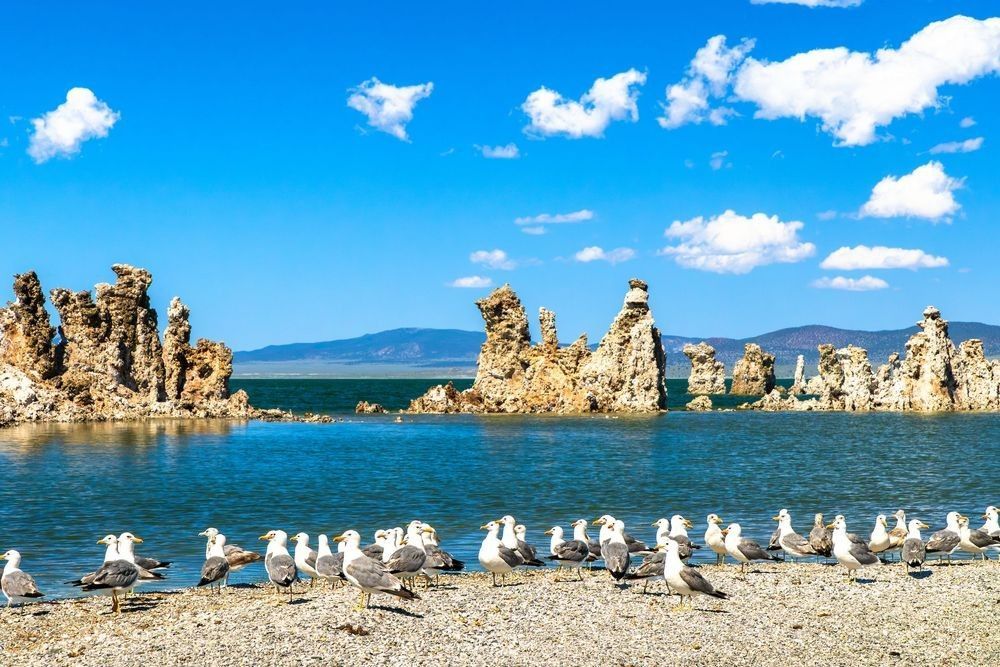
"Tufas at Mono Lake 25" - A large flock of seagulls gathers along the pebble shoreline of Mono Lake at the South Tufa area near Lee Vining, California, in the Eastern Sierra. Tufa formations rise behind the birds, with the aqua-green lake, distant mountains, and a blue sky beyond. A vital habitat for gulls and migratory birds, this is one of California's most iconic and otherworldly natural landscapes.

Tufas at Mono Lake 25 — California gulls on the shoreline with tufa towers and the Eastern Sierra beyond. Click to view fine art print options.

The Wildlife That Made It Into My Frames

Walk close to the shoreline and you’ll encounter the alkali flies — black clouds lifting off the ground ahead of you. It’s one of the more striking things to witness at Mono Lake, and worth understanding: these flies are specifically adapted to the lake’s extreme alkaline chemistry, and along with the brine shrimp, they’re the entire foundation of the food chain here. The lake supports no fish. What it does support, through those two organisms, is somewhere between forty-four thousand and sixty-five thousand nesting California gulls per year — one of the largest breeding colonies in the American West. For photographers, that means bird subjects everywhere, in compositions you can control by moving around the formations.
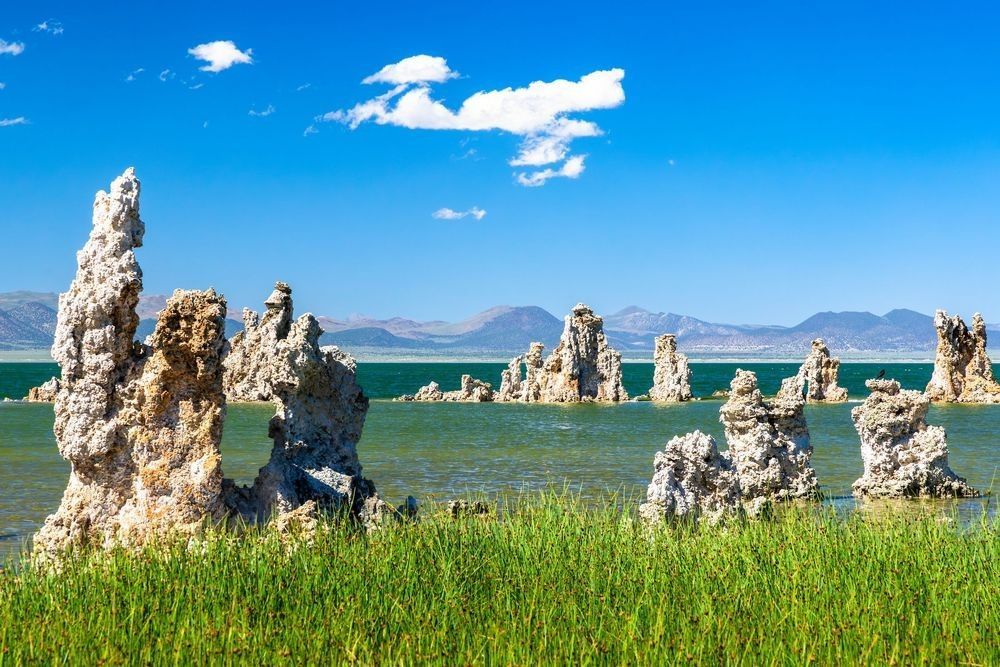
"Tufas at Mono Lake 23" - Tufa formations of varying sizes dot the shoreline and shallow waters of Mono Lake at the South Tufa area near Lee Vining, California, in the Eastern Sierra. Lush green grasses line the foreground, with the aqua-green lake, distant mountains, and a bright blue sky beyond — one of California's most iconic and otherworldly natural landscapes.

Tufas at Mono Lake 23 — formations and lush shoreline grasses at the South Tufa area. Click to view fine art print options.

f/8 and Be There

There’s a saying usually attributed to the photojournalist Weegee — f/8 and be there — and Mono Lake is a good place to think about what it means. The aperture is almost beside the point. The variable that matters is showing up, having the camera in hand when the opportunity is in front of you. I wasn’t there at the right time of day. The session wasn’t planned. I was there because I took a highway turnoff on a drive home and decided that “I’ll come back when the conditions are better” is a promise photographers break more than they keep.

The polarizer handled the conditions. The location did the rest. Some of the images from that afternoon are among my favorites of the year.
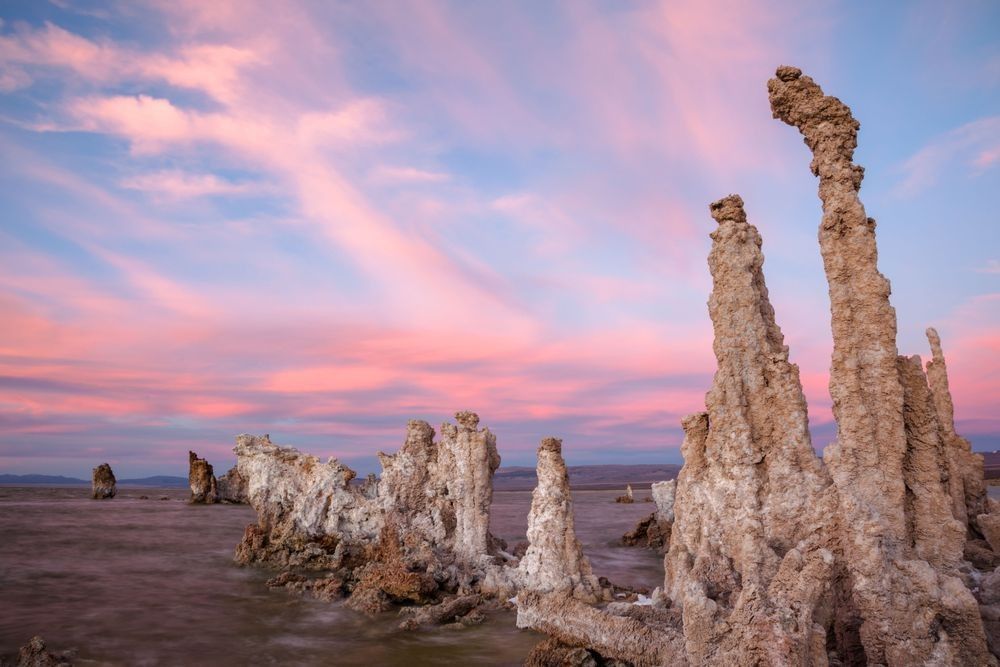
"Sunset at Mono Lake 1" - These tufa were photographed at Mono Lake, CA

Sunset at Mono Lake 1 — from a previous visit in 2010. Golden-hour light tells a completely different story from the same formations. Click to view fine art print options.
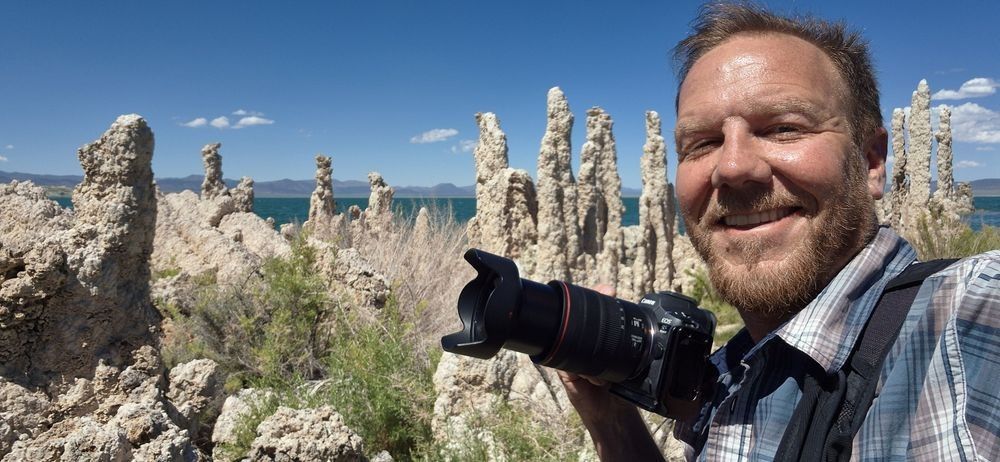
Scott Thompson at the Tufas of Mono Lake, out for some photography fun.

On location at the South Tufa area with the Canon R5 Mark II — a last-minute stop that turned into one of my favorite shoots of the year.

A Few Notes for Photographers Planning the Stop

Cell signal is weak along Highway 395 near Mono Lake. Preload your navigation before you lose coverage — the South Tufa turnoff can be easy to miss if Google Maps won’t load. The access road is well-maintained dirt and gravel, suitable for any vehicle.

Timing: Sunrise and sunset will give you dramatically better light than midday. If midday is what you have, bring a polarizer and work toward the water. Plan your compositions to take advantage of the depth in the scene — foreground formations, mid-ground formations in the water, and the Sierra peaks beyond.

Gear: Circular polarizing filter is close to essential here. Tripod strongly recommended for planned visits. The shoreline can be muddy in spots, so wear shoes you don’t mind getting dirty.

Logistics: Main South Tufa area is three dollars at a credit card kiosk, with restrooms in the parking area. The free western area is a short drive further and worth exploring for the beach and bird compositions. Hat and water for both — it’s high desert with no shade.

The Images: Fine Art Prints Available

The full collection of Mono Lake images from this shoot — along with the 2010 sunset images — is available as fine art prints at TruckeeTahoePhotos.com in the Other Areas Gallery. The tufa formations are a subject that rewards large-format printing — the tonal range and color contrast in these images are best experienced at scale. Metal prints are my recommendation for anything with that Mono Lake blue in it.

Browse the full slideshow below:

Browse Mono Lake Fine Art Prints →

Scott Thompson is a fine art and commercial photographer based in Truckee, California, operating under the brand Scott Shots Photography. His work has been featured in Tahoe Quarterly, the Wall Street Journal, and Robb Report. Fine art prints are available at TruckeeTahoePhotos.com. Commercial photography services at ScottShotsPhoto.com.

Wednesday, July 8, 2026

Fireworks Over Donner Lake, Then the Milky Way Takes Over

Every 4th of July, I climb back out to the same rocky overlook above Donner Lake to shoot the fireworks show. This year I brought new gear along for the hike: a Canon EOS R5 Mark II and a newer version of my go-to 24-105mm lens. I wasn't sure how much of a difference the upgrade would actually make until I got home and started going through the files.


The Fireworks Burst

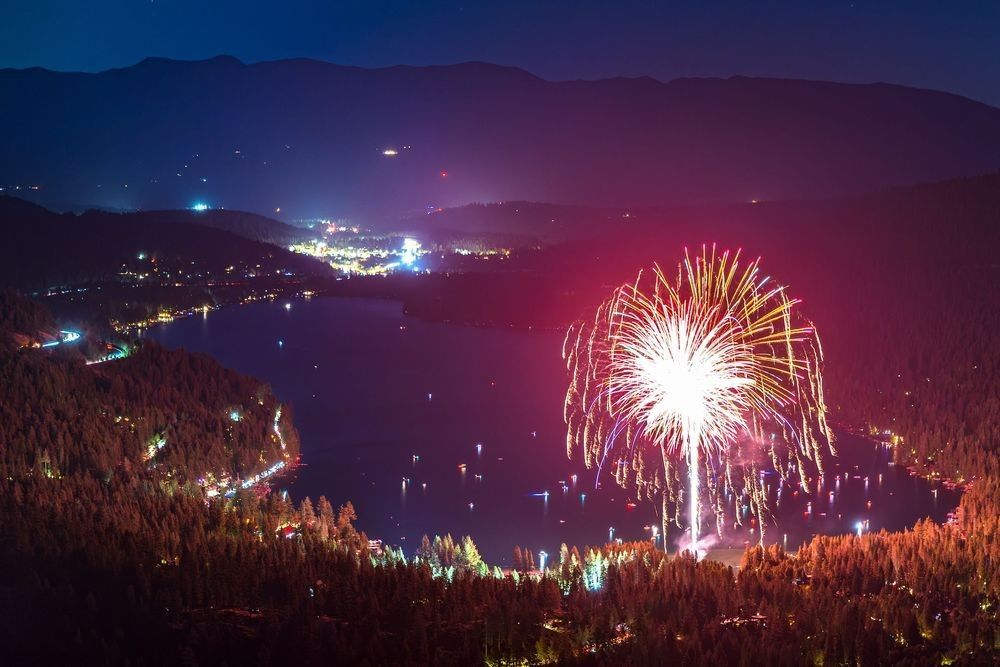
Fireworks display reflecting on Donner Lake near Truckee, California

The burst went off almost directly over the water, with the boats scattered across the lake picking up the color in the reflection. Shot on the R5 Mark II with the RF 24-105mm F4 L IS USM at 81mm, f/4.0, ISO 640, 6-second exposure on a tripod.


After the Show, the Milky Way Took Over

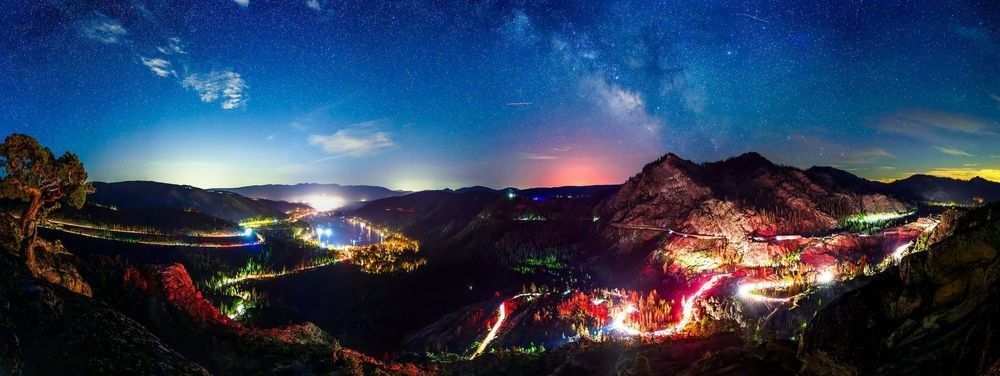
Panoramic night photo of the Milky Way above Donner Lake and Old Highway 40 near Truckee, California

About twenty minutes after the fireworks wrapped up, I stuck around and put together a wide panorama from that same ledge — multiple frames stitched into one very high-resolution image, each shot at 24mm, f/4.0, ISO 1600, 10 seconds per frame. Once the smoke cleared, the Milky Way was right there overhead, with the lights of Donner Lake and Old Hwy 40 curling through the valley below. The final stitched file comes in at roughly 19,000 x 7,100 pixels, which is part of why it makes such a strong large print — there's an enormous amount of detail to work with.


Available as Large Fine Art Prints

Both images are available as fine art prints in canvas, metal, and framed options, in sizes well beyond what you'd find at a typical print shop. The fireworks shot has the kind of deep-black, high-contrast color that looks especially striking as a metal print, and the panorama's resolution means it can go very large — a feature wall above a fireplace or a long hallway — without losing detail. You can view sizing and order either one directly: Fireworks at Donner Lake or Old Hwy 40 At Night.


A Quick Look From the Ledge

Here's a short Reel I shot from the same spot right before the show started:


Scott Thompson is a fine art photographer based in Truckee, California, specializing in Lake Tahoe and Sierra Nevada landscapes. Prints of these images, and the rest of his Truckee-Tahoe catalog, are available at TruckeeTahoePhotos.com.

Thursday, June 25, 2026

Introducing Outdoor Adventure & Lifestyle Photography

I'm excited to share something brand new: Outdoor Adventure & Lifestyle Photography is officially live on my website. It's a new way for me to document the things you're already doing around Lake Tahoe and Truckee — skiing a storm day, hauling in a trophy trout, paddling out at sunrise, or anything in between — and turn it into photos and wall art you'll actually want to keep.


A Different Kind of Session

This isn't studio photography, and it isn't a posed outdoor portrait session either. For most adventures, I come right along with you — skiing next to you, riding in the boat or kayak, hiking the trail alongside — so what you get back actually looks like your adventure, not a staged version of it.

I cover a lot of ground (and water, and snow): skiing, snowboarding, boating, fishing, whitewater kayaking, rock climbing, backpacking, mountain biking, even private plane and helicopter sessions — with aerial drone photos available as an add-on through my FAA Part 107 certification. The full list of adventures I shoot is on the new page, and if yours isn't on it, ask — there's a good chance I can still make it happen.

Cross-country skiing adventure photography session above Donner Lake

Cross-country skiing above Donner Lake.


What's Included

Every session includes a 20×30 metal print, shipped right to you, plus a set of medium-resolution digital downloads perfect for sharing on social media or your blog. Want more to hang on the wall? Additional prints in metal, acrylic, canvas, and more are available through my print shop at TruckeeTahoePhotos.com, and full-resolution digital files can be added too. Since every adventure is different, pricing is put together once I know what you have planned — there's no one-size-fits-all package.

Father and son holding a trophy Lahontan cutthroat trout while fishing at Pyramid Lake, Nevada

A father-son trophy catch — Pyramid Lake, Nevada.


Booking a Session

Ready to book? Fill out my Adventure Booking Questionnaire — a fillable PDF that asks about your activity, group size, timing, and a few other details — and email it back to me so I can put together a custom quote.

👉 Download the Booking Questionnaire (PDF) →


See More

Here's a quick look at the kind of moments I'm talking about — including a bush plane touchdown at Stampede Reservoir, surrounded by wildflowers.

Adventure & lifestyle photography samples — Scott Shots Photography.


Ready to Plan Your Adventure?

Whether it's a milestone birthday, an anniversary, a bachelor or bachelorette trip, or just an adventure you don't want to forget, I'd love to help you document it. Head over to the new page for the full list of adventures I shoot, how sessions work, and everything that's included.

👉 Visit the Outdoor Adventure & Lifestyle Photography page →

Or reach out directly: scottshotsphoto@gmail.com | (530) 277-7890


Scott Thompson / Scott Shots Photography — Truckee, California. Photographing the Lake Tahoe, Truckee, and greater Sierra Nevada region since 2002. FAA Part 107 Certified drone pilot and 2020 Best Local Artist. Visit ScottShotsPhoto.com to learn more.

Wednesday, June 3, 2026

How to See a Lake Tahoe Print on Your Wall Before You Buy

Every print I sell tends to start with the same quiet question: “Will it actually look right on my wall?” It’s the hardest part of buying art online — you fall for an image on screen, but you can’t quite picture it above the couch, and you’re not sure what size to order. That’s exactly the problem my favorite tool solves, so I want to give you a quick look at how it works.


What is Live Preview AR?

Live Preview AR is a free augmented-reality tool built right into my website, truckeetahoephotos.com. Using the camera in your phone or tablet, it places any of my Lake Tahoe and Truckee prints onto your real wall, at close to real-world scale — no app to download and no sign-up required. You see the actual image, in your actual room, in your own light.

How it works — the quick version

You really don’t need a manual to get going:

  1. Open any image on the site and tap the Live Preview AR button.
  2. Allow your camera when your phone asks, then point it at the wall.
  3. The print appears on your wall — step back, move around, and see how it feels in the space.

That’s the heart of it. For the full walk-through — exactly where to find the button, how to choose a size, and how to switch between views — I put together a complete step-by-step guide, linked below.

One honest thing about size

I’ll always be straight with you: the size you see on screen is a close estimate, not an exact measurement — it depends on your phone, its lens, and how far back you’re standing. So once the preview helps you land on a size you love, grab a tape measure and mark it on the wall to confirm before you order. The preview shows you the feeling; the tape measure confirms the fit.

Bonus: try it against your wall color

There’s also a Wall Preview mode that drops the image into a clean room and lets you change the wall color. It’s a great way to see how an image’s colors play against your paint before you commit — especially handy for bold sunset shots and the abstract water reflections.


See it on your own wall

Want the full how-to — plus before-and-after photos, a customer’s 5-star review, and a QR code you can scan to try it on the spot? Head over to the complete guide on my main site:

See Any Print on Your Wall Before You Buy

Then browse the galleries, pick an image you love, and watch it land on your wall.

Quick questions

Do I need to download an app?

No. Live Preview AR runs right in your phone or tablet’s web browser — there’s nothing to install.

What devices work?

Just about any reasonably current iPhone, iPad, or Android phone or tablet. You only need to allow camera access when prompted.

Does it show the exact print size?

It shows a close estimate of scale, which is perfect for getting a feel for the room. Always confirm the final size with a tape measure before ordering.

Is it free?

Yes — it’s completely free to use on every print page, with no account required.

Give it a try. It’s genuinely fun, and it takes the guesswork out of choosing art for your home. See you out there — and on your wall.