
Last week I had the chance to photograph a completed art installation for the Piper Gallery at a private residence in Martis Camp. For those unfamiliar, Martis Camp is one of the most exclusive private communities in the Truckee–Tahoe region — the kind of place where the homes genuinely need to be seen to be believed. My role was to document the artwork the gallery had placed throughout the property, producing images for marketing, social media, and client presentations.
It was a fantastic shoot. And it drove home something I’ve been thinking about for years.
On location at a private Martis Camp residence, photographing an art installation for the Piper Gallery. (If the video doesn’t load, watch it on Instagram.) Scott portrait photos provided by Piper Gallery.
The Art Inside Tahoe’s Best Homes Looks Different Now
I’ve spent a long time photographing homes across the Truckee and Lake Tahoe area — first as someone who simply fell in love with this landscape, and more recently as a commercial and real estate photographer invited inside some truly exceptional properties. Through collaborations with talented local designers like Elisa Dinallo of Dinallo Designs, I’ve had a front-row seat to how the art in these spaces has evolved.
What I’m seeing: traditional landscape photography — the perfectly composed, perfectly exposed postcard view of Lake Tahoe — has become increasingly rare on the walls of the most beautiful homes I photograph. In its place are large-scale paintings with visible texture and movement, abstract photography, and images that generate an emotional response before you’ve even processed what you’re looking at. Statement pieces that anchor a room, rather than collections of smaller prints arranged to fill space.
This isn’t just my personal observation. Interior designers and design media have been tracking the same shift. The prevailing direction in 2025 and 2026 is toward art-driven interiors — fewer works, chosen with more intention, with a clear preference for the painterly, the atmospheric, and the abstract. The Martis Camp home I photographed for Piper Gallery was a textbook example: every piece of art had been selected to work with the architecture and the quality of light — not just to depict a place, but to shape how the room feels.
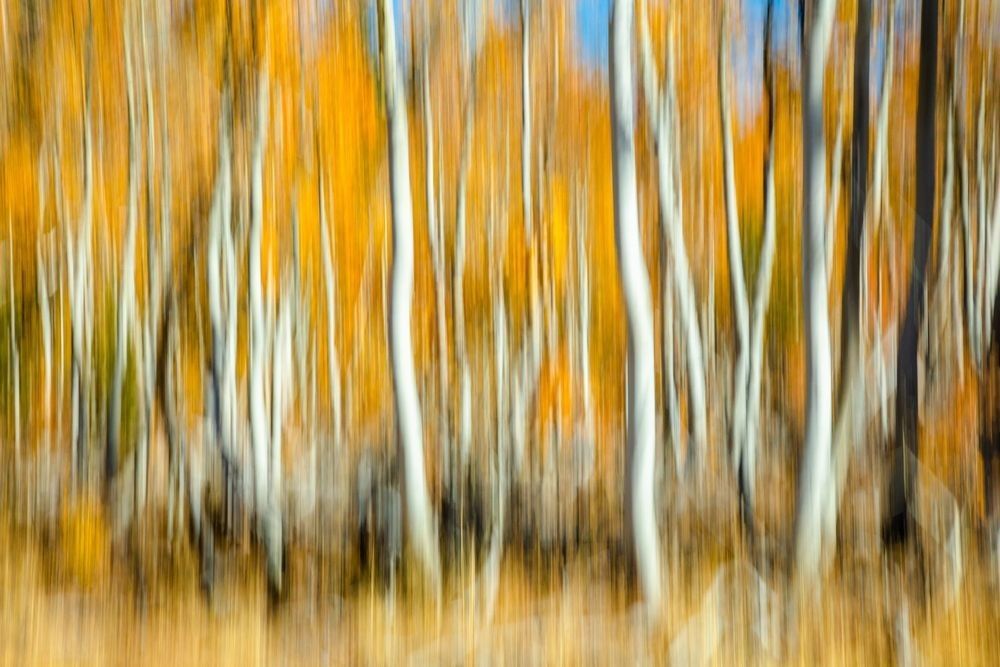
Autumn Abstract 2 — intentional camera movement transforms a stand of aspens into something closer to a painting than a photograph.
The Foundation Came Before the Camera
Here’s what makes this particularly resonant for me — this isn’t a trend I’m chasing. It’s a way of seeing I’ve been cultivating for close to thirty years.
Before photography, I was taking painting and drawing classes. Those classes gave me a framework for thinking about composition, color theory, light, and mood — not as technical requirements, but as instruments for generating an emotional response. When I picked up a camera, I was already thinking like a painter.
That foundation was reinforced by one of the best teachers I’ve had. In college, I studied black and white photography under Richard A. Lou, who remains one of the most influential educators I’ve encountered. He challenged us to think of the final print as an artwork in its own right — not a mere record of what stood in front of the lens. His assignments pushed hard in the best possible way. One of his standing rules, which still makes me smile: no pictures of cats. It sounds like a joke, but it was his shorthand for something serious — stop reaching for the comfortable and obvious, and start genuinely thinking about what you’re making.
I tracked Richard down on LinkedIn not long ago and sent him a note. Thirty years on, his voice is still with me every time I go out to shoot.
A few years after that class, I came across Art Wolfe’s book The Art of Photographing Nature, and it crystallized everything I’d already begun to understand. Wolfe’s ability to find the graphic, the painterly, and the unexpected within natural landscapes — to treat scenery as raw material for abstraction rather than as the finished product — was a genuine revelation. If you care about nature photography as an art form, it’s worth hunting down a copy.
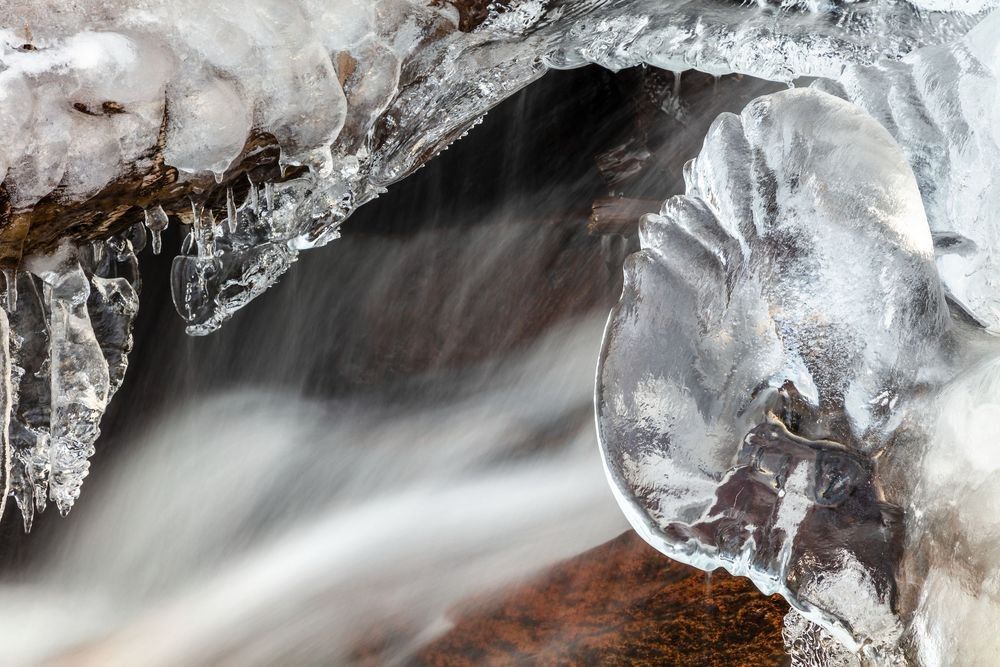
Icy Eagle Falls — water, ice, and long exposure combine into something more sculpture than snapshot.
The Tahoe Area Abstract Gallery
All of that history — the painting classes, Richard’s assignments, Art Wolfe’s influence, two-plus decades of photographing this region — is alive in a gallery I’ve been developing on TruckeeTahoePhotos.com. I recently expanded it substantially, and I want to make sure it’s on your radar, especially if you’ve primarily thought of my site as a source for traditional Tahoe landscape photography.
The Tahoe Area Abstract Gallery is something different. It gathers images that blur the line between photography and painting — long exposures that transform moving water into something silky and dreamlike, aerial drone perspectives that reduce the Sierra Nevada to pure color and pattern, ice and granite close-ups that feel almost sculptural, and intentional camera movement that renders a forest as something impressionistic. These are the images I’m most proud of. And increasingly, they’re the images that look most naturally at home in the spaces where people actually live.
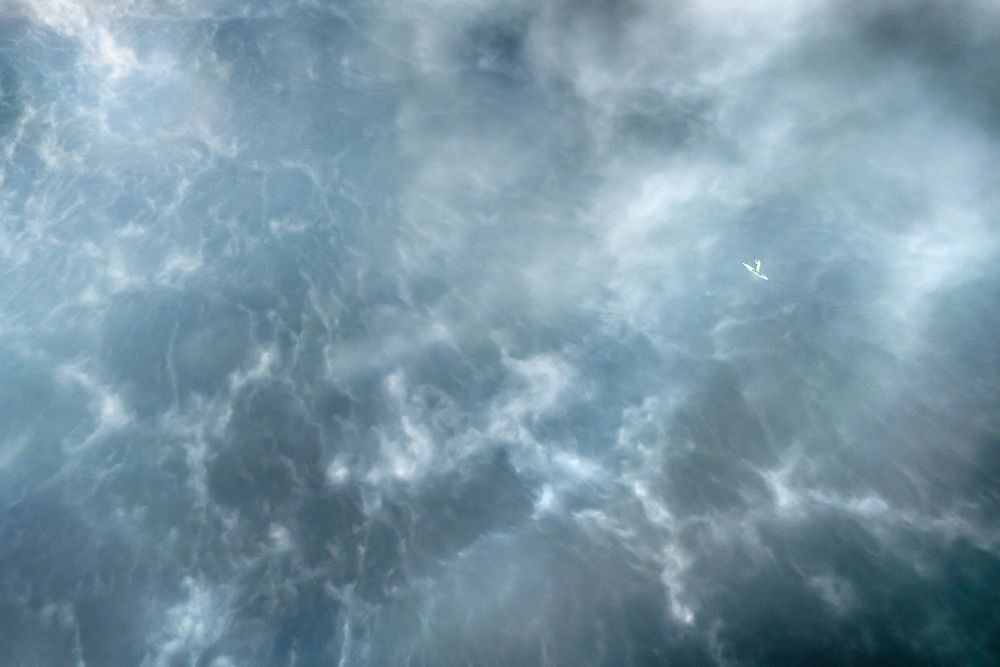
Donner Lake Aerial 7 — from above, the lake’s surface becomes something closer to abstract painting than geography. Note: A small paddle boarder can be seen on the lake.
Print Size and Material: What to Know
If you’re thinking about one of these images for your home, a few considerations are worth keeping in mind.
Abstract and painterly photography rewards scale. A 16x24 print of a snow abstract is beautiful. That same image printed at 40x60 becomes something that defines the room. In my experience seeing prints across many different homes, most people underestimate how large to go — particularly with images that have significant tonal depth and visual complexity. My catalog goes up to 72x48 inches, and I’m happy to provide a custom quote for anything larger.
On the question of material: for images with movement, soft gradation, and texture — snow abstracts, water long-exposures, foggy winter scenes — metal prints are my strong recommendation. Metal enhances mid-tone contrast in a way that gives these images a subtle luminosity that’s hard to articulate until you’ve seen it firsthand. They appear almost self-illuminated. Metal also integrates cleanly into modern interiors because no frame is needed — the finished print is ready to hang.
For images with rich, warm color — autumn aspen work, aerial lake views — canvas adds a softness and warmth that can feel more painterly, and suits certain spaces beautifully.
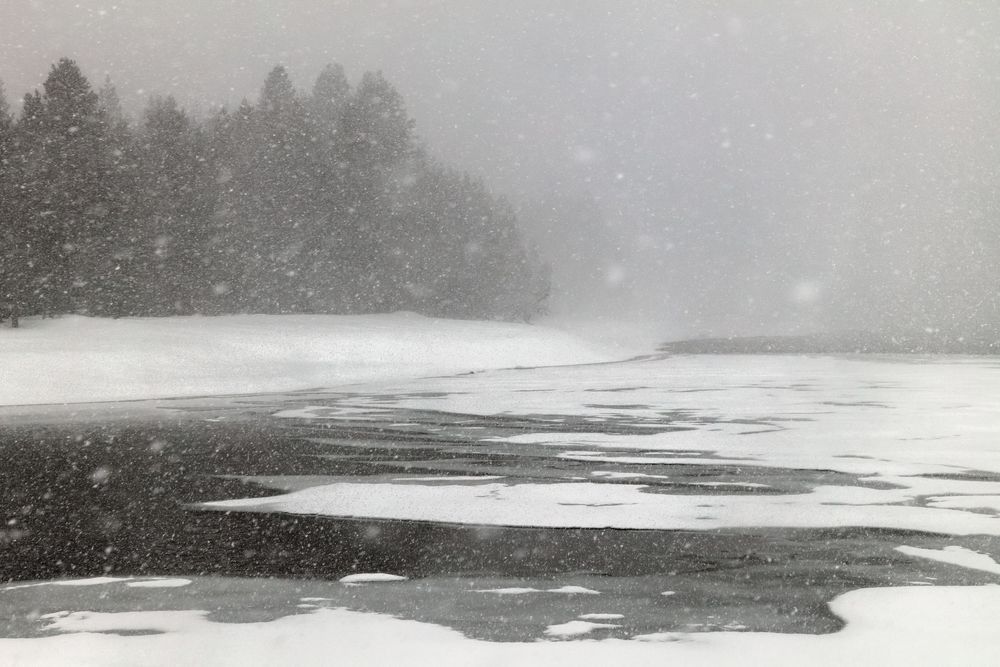
Snowy Donner Lake 13 — snow and ice on the surface of Donner Lake in Truckee, California. Large format metal prints bring out a luminosity in abstract images that’s hard to achieve any other way.
A Note for Interior Designers
If you’re a designer or decorator with a project in the Truckee–Tahoe area — or beyond — I’d love to connect. I understand how critical it is to find artwork that doesn’t just look beautiful in isolation, but genuinely functions within the specific light, scale, and color palette of a real room. I’m glad to discuss your project, supply high-resolution files for client presentations, and help identify the right image and format for your installation.
You can reach me anytime through my contact page.
Take a Look
Whether you’re furnishing a vacation home, working with a designer on a Tahoe property, or simply looking for wall art that goes somewhere more unexpected — I’d encourage you to spend a few minutes in the gallery. These are among my favorite images from more than two decades spent photographing this region, and they represent what becomes possible when photography stops trying to be a postcard and starts trying to be art.
Browse the Tahoe Area Abstract Gallery →
Scott Thompson is a fine art and commercial photographer based in Truckee, California. His work has been featured in Tahoe Quarterly, the Wall Street Journal, and Robb Report, and is available for purchase at TruckeeTahoePhotos.com and through Art Truckee Gallery in Downtown Truckee.

